01 / Plasma composition
Heavy ions & the ring current
Investigating how heavy ion populations shape ring current decay and plasmaspheric refilling during geomagnetic storms.
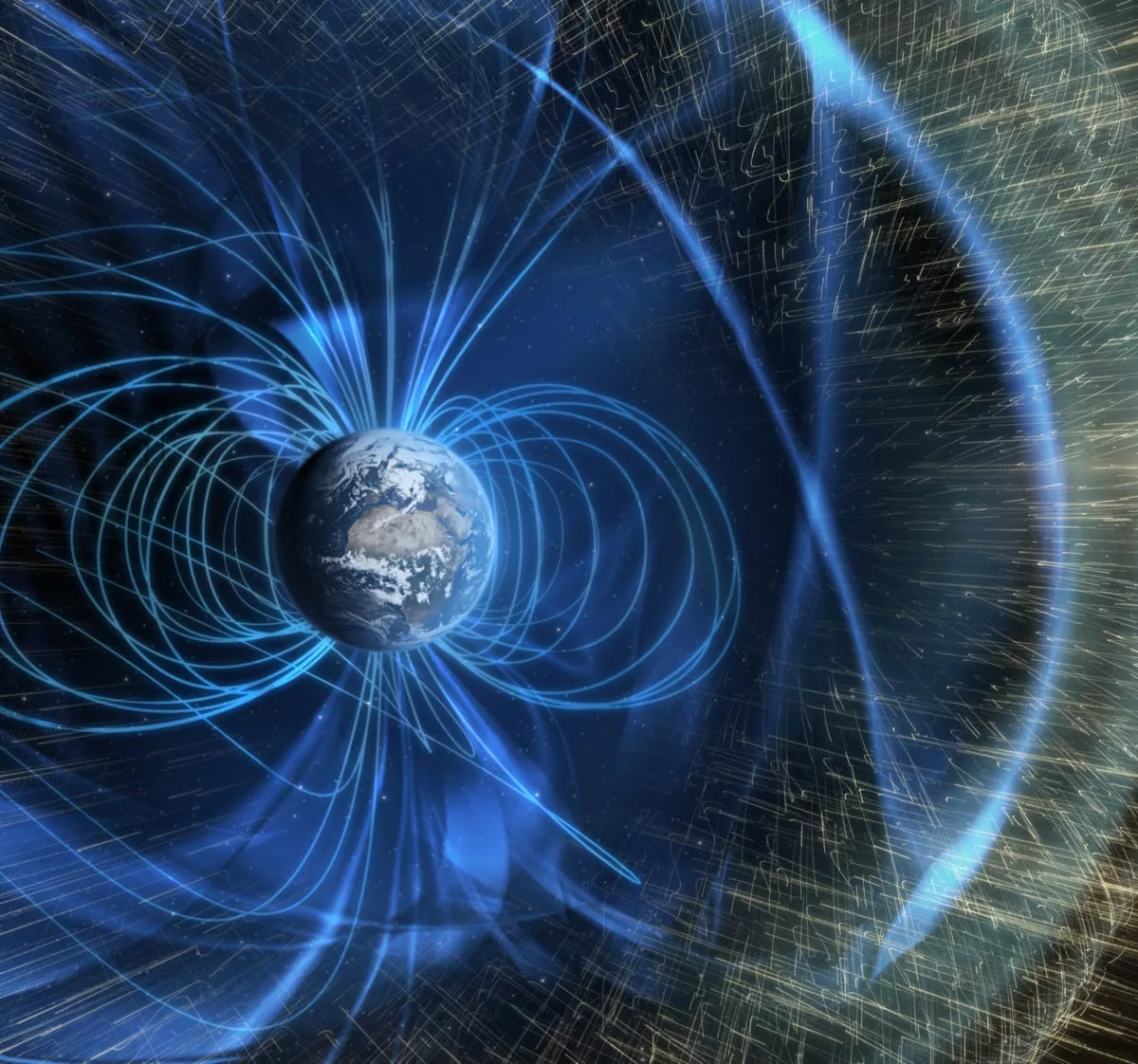
Computational space physics
I’m Pedro Silva, a Ph.D. candidate studying how particles, fields, and plasma shape Earth’s space environment.
Electrical & Computer Engineering
University of Illinois Urbana–Champaign
Explore / Interactive 3D
Change the solar wind. Follow a field line.
Explore how Earth connects to space.
Preparing the 3D magnetosphere…
The Dungey cycle
Select a stage to pause and inspectWith southward IMF, oppositely directed fields reconnect on the dayside. A closed terrestrial field line becomes two open lines, each with one end anchored to Earth.
This is a kinematic teaching model, not a numerical MHD solution or a forecast. Magnetic field lines show topology; moving pink markers show conventional current direction, while green particles represent auroral precipitation. The diffuse torus and plasma sheet use illustrative relative-pressure shading; amber markers trace drift and bulk plasma transport. Cyan plumes and upward-moving tracers represent thermal polar ion outflow, not auroral precipitation. Polar wind continues under northward IMF. Field-line motion, plasma flow, and electrical current are different quantities.
The dayside distance uses proton dynamic pressure P = mₚnv² and a dipole pressure-balance scaling of 10 RE at 2 nPa (distance ∝ P−1/6). The remaining geometry is schematic. The tail is truncated; auroral altitude and current thickness are enlarged for visibility. Pressure volumes, transport speeds, animation time, and auroral brightness are illustrative. The asymmetric ring-current plasma volume is inspired by high-pressure regions in simulation visualizations; it is not a fitted HEIDI distribution. IMF By, dipole tilt, northward-IMF lobe reconnection, Region 2 currents, and substorm timing are omitted.
Visualization references: NASA: ring-current pressure volume · NASA: magnetotail fields and flow · NASA: polar wind. Physics: NASA: reconnection and the Dungey cycle · NASA: current systems. Earth texture: NASA Earth Observatory.
01 / Research
How do heavy ions influence the way Earth’s magnetosphere responds to a geomagnetic storm?
I develop physics-based computational models to investigate ring current decay, plasmaspheric refilling, and the connections between them.
Explore publications01 / Plasma composition
Investigating how heavy ion populations shape ring current decay and plasmaspheric refilling during geomagnetic storms.
02 / Coupled modeling
Developing the Hot Electron–Ion Drift Integrator and its coupling to BATS-R-US within the Space Weather Modeling Framework.
03 / Computational methods
Combining high-performance computing with an interest in graph neural networks and diffusion-based surrogates for space weather modeling.
02 / Selected work
Frontiers in Astronomy and Space Sciences
Read articleAGU Fall Meeting Abstracts
Find on Google Scholar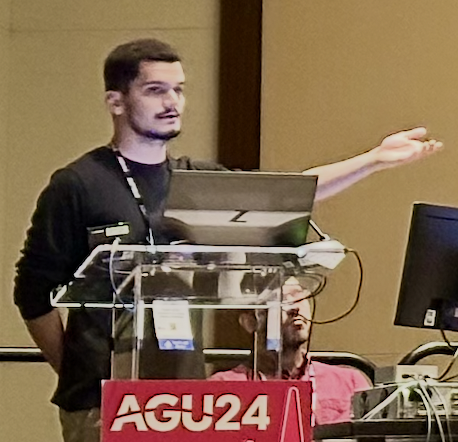
03 / About me
I’m a Ph.D. candidate in Electrical and Computer Engineering at the University of Illinois Urbana–Champaign, advised by Prof. Raluca Ilie.
My work sits at the intersection of space physics, high-performance computing, and machine learning. I’m interested in building models that bring together physical fidelity and computational scalability.
I also teach electromagnetics, using interactive visualization to help students connect field theory with physical intuition.